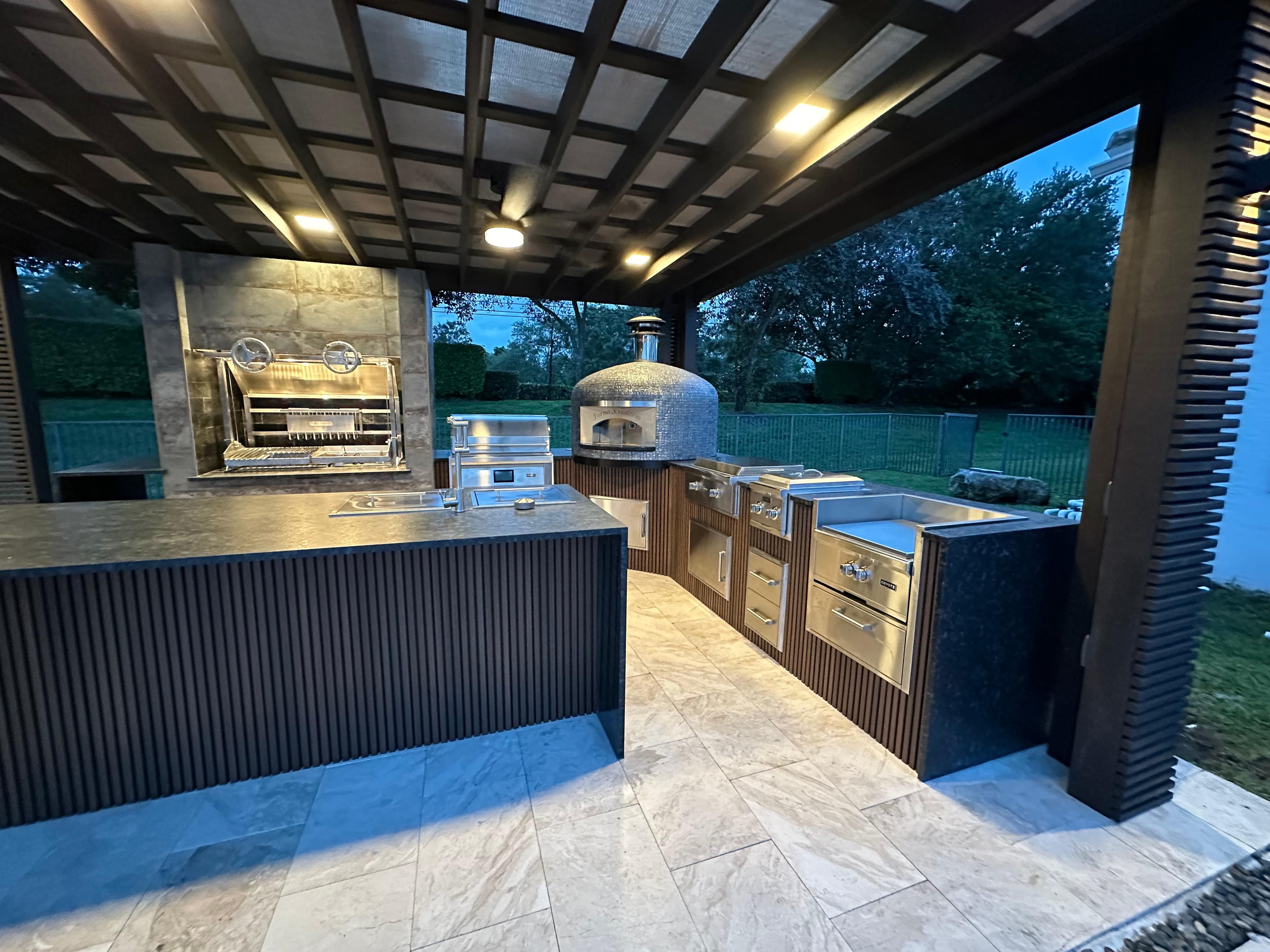
The best pool lighting setup for Florida right now: color-changing LED fixtures in the pool, warm low-voltage accent lighting around the deck, and smart controls that run scenes from your phone — LED because it uses a fraction of the energy of old halogen bulbs and survives our heat, storms, and salt systems. Here's how to choose and combine them.
The right pool lighting transforms your backyard from ordinary to extraordinary. Whether you're hosting evening parties or enjoying a quiet night swim, proper lighting creates ambiance, enhances safety, and extends your pool's usability into the night.
Why does pool lighting matter for your backyard?
Beyond aesthetics, pool lighting provides:
- Safety: Illuminates steps, edges, and depth changes
- Ambiance: Creates a resort-like atmosphere
- Extended Use: Enjoy your pool after sunset
- Home Value: Increases property appeal and value
What are today’s top pool lighting trends?
1. LED Color-Changing Lights
LED technology has revolutionized pool lighting with endless color options and energy efficiency.
Features:
- 16+ million color combinations
- Remote or smartphone control
- Energy savings of 80% vs incandescent
- 50,000+ hour lifespan
Best Use: Perfect for pools with entertainment areas. Create different moods with color themes for parties or relaxation.
Where it sits: mid-range, priced per fixture — the most common upgrade we install
2. Fiber Optic Lighting
Fiber optics create a starry night effect without electricity in the water.
Features:
- No electrical current in pool
- Extremely safe
- Creates twinkling star effect
- Very low heat output
Best Use: Perimeter lighting, step markers, and waterfall accents. Creates a magical, subtle glow.
Where it sits: premium — priced for the whole run rather than per light
3. Underwater LED Strips
Modern LED strips provide smooth, even illumination along pool walls and floors.
Features:
- Continuous ribbon of light
- Waterproof and durable
- Flexible installation
- Energy efficient
Best Use: Highlighting pool shape, creating modern aesthetic, illuminating tanning ledges.
Where it sits: scales with pool size, since you are lighting a length rather than a point
4. Floating LED Lights
Portable and fun, floating lights add versatility to your lighting scheme.
Features:
- Solar or battery powered
- Waterproof
- Color-changing options
- Easy to move and store
Best Use: Special occasions, parties, or creating focal points. Great for adding temporary ambiance.
Where it sits: the least expensive option by a wide margin, and the only one you can add yourself
5. Landscape Integration
Don't forget the area around your pool!
Features:
- Path lighting for safety
- Uplighting for trees and features
- Wall washing for fences
- Accent lighting for landscaping
Best Use: Creating a cohesive outdoor environment that extends beyond the pool.
Where it sits: scales with how much of the yard you light — a few path fixtures is a modest job, a full scheme is a project
How does smart pool lighting control work?
Modern pool lighting systems integrate with home automation:
- Voice Control: "Alexa, turn the pool lights blue"
- Scheduling: Automatic on/off at sunset/sunrise
- Scenes: Save favorite color combinations
- Remote Access: Control from anywhere via smartphone
Popular systems:
- Pentair IntelliBrite
- Hayward ColorLogic
- Jandy Pro Series
- Universal automation platforms (Control4, Savant)
Which pool light colors work best for each mood?
Different colors create different moods:
- Blue: Tranquil, sophisticated, timeless
- Green: Natural, calming, tropical
- Purple: Romantic, luxurious, dramatic
- Red: Energetic, bold, festive
- White: Clean, classic, bright
- Amber: Warm, inviting, cozy
How much energy do LED pool lights save?
LED lighting dramatically reduces energy costs:
Old Incandescent:
- 500W per light
- 2,000-hour lifespan
- High heat output
- Frequent bulb replacement
Modern LED:
- 30-40W per light (90% reduction)
- 50,000-hour lifespan (25x longer)
- Minimal heat
- No bulb replacement for years
What that means on the bill:
- Four pool lights running six hours a night
- LEDs draw roughly a tenth of what the old incandescents did
- The lighting line on your power bill drops by around 90%, and you stop replacing bulbs every couple of years
What does pool lighting installation involve?
DIY vs. Professional
DIY Appropriate:
- Floating lights
- Above-water landscape lighting
- Solar-powered options
Requires Professional:
- In-pool LED installations
- Fiber optic systems
- Underwater electrical work
- Integration with automation systems
Safety Requirements
All pool lighting must meet safety codes:
- GFCI protection required
- Proper bonding and grounding
- Appropriate wire gauge for underwater
- Sealed junction boxes
- Licensed electrician for installation
How do you maintain pool lights in Florida?
Keep your pool lights shining bright:
- Clean Regularly: Remove calcium buildup monthly
- Check Gaskets: Inspect seals annually
- Monitor Performance: Replace dimming LEDs before failure
- Update Controls: Keep automation software current
- Professional Inspection: Annual electrical check
Which lighting design fits your pool style?
Modern/Contemporary
- White or cool blue LEDs
- Clean, bright illumination
- Minimal fixtures
- Integrated strips
Tropical/Resort
- Warm amber and turquoise combinations
- Landscape uplighting on palms
- Tiki torch integration
- Waterfall accent lights
Classic/Traditional
- Soft white pool lights
- Warm landscape lighting
- Classic fixture styles
- Understated elegance
Entertainment-Focused
- Color-changing RGB system
- Synchronized light shows
- High output for parties
- Multiple zones for control
What pool lighting mistakes should you avoid?
Even well-designed systems fall short when a few common errors creep in. Watch for these before finalizing your plan:
Under-sizing the transformer. A transformer sized exactly to current load leaves no headroom when you add fixtures later, or when long cable runs cause voltage drop. Size 20–30% above current draw so the system stays healthy and expandable.
Mixing color temperatures. Combining 3000K landscape fixtures with 6500K pool lights produces a washed-out, mismatched look. Pick one temperature per zone — warm for patio and landscape, cooler for in-pool — and stay consistent across the installation.
Ignoring glare and hot spots. Fixtures aimed directly at seating areas or neighbor windows create nighttime glare that ruins ambiance. Aim lights at surfaces (walls, plants, water features) rather than into sightlines, and use shielded fixtures where possible.
Forgetting a maintenance plan. A system with 40 LED fixtures will have failures at some point. Keep spare modules on hand, document which channels control which zones, and schedule an annual electrical inspection with a licensed professional.
Cheaping out on controls. A high-end LED system paired with the cheapest mechanical timer on the shelf feels unfinished. Set aside a meaningful slice of the total lighting budget for reliable control hardware — Pentair ScreenLogic, Hayward OmniLogic, or a Control4/Savant integration.
Skipping the mock-up. Before committing to a full installation, ask your contractor to set up two or three sample fixtures and run them after dark. Colors, brightness, and placement look completely different on a spec sheet versus on the water.
Overlooking permits. In Broward County, unpermitted in-pool electrical work can fail a home inspection years later and create liability for the homeowner. Always confirm your installer pulls the permit.
What makes Florida pool lighting different?
Most lighting guides assume moderate climates. If you own a pool in Weston, Pembroke Pines, Miramar, or anywhere in Broward County, your fixtures face conditions that shorten lifespan and demand specific material choices.
Humidity and condensation. South Florida's year-round humidity pushes moisture into any fixture that isn't rated for wet or damp locations. Transformers, timers, and automation enclosures near the equipment pad should be housed in NEMA 3R or better outdoor enclosures. LED drivers rated IP67 or higher survive significantly longer than IP65 in daily-rain climates.
Salt-air corrosion. Pools within 10 miles of the coast — most of eastern Broward — see accelerated corrosion on any metal fixture. Stainless steel grade 316, not the cheaper 304, is the minimum spec for landscape lighting housings, deck-mounted brackets, and visible hardware. Brass fixtures with powder-coat finishes hold up well. Avoid zinc die-cast housings: they pit and fail within 2–3 years near the coast.
UV exposure. Florida's UV index regularly hits 10+ in summer. Cheap acrylic lenses cloud and yellow within two years. Tempered glass or UV-stabilized polycarbonate keeps optics clear for the full 50,000-hour LED lifespan.
Hurricane-rated fixtures. Landscape and above-pool lighting should be rated for wind-borne debris zones per Florida Building Code. Low-profile, recessed, and ground-mounted fixtures survive where tall post-lights fail. Wall-mounted fixtures near the pool should be storm-anchored or removable.
Do pool lights need a permit in Broward County?
All in-pool electrical work in Broward County requires a licensed electrical contractor and a permit pulled through your municipality — Weston, Pembroke Pines, Miramar, Davie, and neighboring cities each run their own building department. The relevant code is Florida Building Code Chapter 27 (Electrical), which adopts NEC Article 680 with local amendments covering pool and spa wiring.
Items homeowners are often surprised by:
- Bonding grid. Any metal within 5 feet of the pool edge must be bonded — fixtures, rebar, rails, and certain deck materials. A bonding violation is a life-safety issue, not paperwork.
- GFCI protection. Required on every circuit feeding pool lighting, underwater fixtures, and any outlet within 20 feet of the pool.
- Pool-duty transformers. Low-voltage pool lights require a listed pool-duty transformer with secondary GFCI — not a generic landscape transformer.
- Inspection. Work must pass rough and final electrical inspection before the pool is refilled and energized.
Blue Clair Pool handles permitting, licensed electrician coordination, and inspection scheduling as part of our service and repair and renovation work, so you don't navigate the county's permit portal on your own.
Thinking Bigger Than Lighting?
New lighting delivers the most dramatic result when it's planned alongside the surfaces it illuminates. If your pool is due for resurfacing or new tile and decking, bundling the electrical work into a full renovation saves on labor and gives the designer a blank canvas — glass tile and quartz finishes in particular transform under LED color.
Curious what a project like that runs in Broward County? Our free pool renovation cost estimator gives you a ballpark range in under a minute — no email required. And for lighting beyond the waterline, see our landscape lighting work: path, deck, and accent lighting designed to match the pool's nighttime look.
Conclusion
Pool lighting has evolved far beyond basic illumination. With modern LED technology, smart controls, Florida-rated materials, and creative design, you can create a stunning nighttime environment that holds up to salt air, humidity, and hurricane season.
Ready to illuminate your pool? Contact Blue Clair Pool for a custom lighting design and professional installation in Weston, Pembroke Pines, Miramar, and across Broward County. We handle permits, licensed electrical work, and material selection so your new lighting survives Florida's climate for the full life of the fixtures.