Pool Repair vs Remodel: Framing the Decision
You walk out to the patio, and something about the pool no longer feels right. Maybe the pump has started to labor. Maybe the surface feels rougher under your feet, or the waterline tile has begun to stain. The question that follows is a fair one: do you fix the problem in front of you, or is it time to renovate the whole pool?
This guide gives you a calm, practical way to decide. It draws on six-plus years of repair and renovation work across Weston, Davie, and Pembroke Pines, and on more than 500 pools serviced.
Is renovating the same as remodeling? Plain-language definitions
In everyday conversation, the two words overlap. Renovating restores what you already have: a new surface, fresh tile, repaired coping, updated equipment. Remodeling changes the design: a different look, new features, a reworked edge or lighting scheme. Most projects blend both, which is why we treat them as one conversation under pool renovation. Repair, by contrast, fixes a specific failure and leaves the rest of the pool as it is.
Why the right answer depends on the pool's condition, not a rule of thumb
You will hear rules of thumb, such as replace anything past a certain age. We do not rely on them. A well-kept pool can age gracefully, while a neglected one can fail early. The decision belongs to the pool in front of you: its surface, its structure, its equipment, and how often it has needed service.
What this guide covers, and who it is for
This guide is written for homeowners in Weston, Davie, and Pembroke Pines who already have an inground pool. We cover the decision criteria, the repairs that stand on their own, the signs of a pool that needs a remodel, the tipping point between them, bundling, permits, timing, and a short checklist. Blue Clair Pool does not build new pools, so everything here concerns the pool you own today.
The Criteria That Separate a Repair From a Remodel
Five questions do most of the work. Answer them honestly and the right path usually becomes clear.
Five criteria
- Age and condition of the surface. A surface that is smooth and sound points toward repair. One that is rough, stained, or shedding points toward a remodel.
- Frequency of repairs. One isolated fix is routine. A pattern of fixes is a signal.
- Safety and structure. Loose coping, cracks, and uneven edges affect people walking around the pool, not just the water inside it.
- How you use the space. If you entertain, swim with children, or want the patio to feel like an extension of your home, the pool's look and layout matter as much as its function.
- Long-term value. A pool in good repair supports your property's value. A tired one quietly works against it.
Side-by-side comparison
| Criterion | Repair | Remodel |
|---|---|---|
| Surface condition | Sound, with a localized flaw | Rough, stained, or shedding across the pool |
| Repair history | One isolated issue | Repeated calls for the same problem |
| Safety and structure | Edges and coping intact | Coping loose, cracked, or uneven |
| Use of the space | Pool works as you want it to | You want a new look, layout, or features |
| Long-term value | Protects what you have | Raises the pool's appeal and function |
| Relative cost | Lower up front | Higher up front, with fewer repeat visits |
| Strengths | Fast to scope, less disruption, targeted | One coordinated fix, a cohesive finish, longer-lasting results |
| Weaknesses | Does not address aging elsewhere | Larger commitment and more planning |
| Best for | Sound pools with one clear failure | Pools where several parts are aging together |
How to read the table
The cost row is relative only. Actual numbers depend on your pool's size, condition, and the scope you choose. For real figures, use our pool cost estimator, then confirm them with a free on-site quote.
Repairs That Make Sense on Their Own (Equipment, Tile, Leaks)
Not every problem is a warning sign for the whole pool. Some repairs are the right and complete answer. Our pool repair services cover these cases, and each follows the same principle: the fault is isolated, and the rest of the pool is sound.
Equipment: pumps, heaters, salt cells, and automation
Equipment fails on its own schedule. A worn pump motor, a heater that no longer holds temperature, or a salt cell at the end of its life can be replaced without touching the pool's surface. Upgrading is often smarter than swapping like for like. A variable-speed pump adjusts its output to what the pool needs at that hour, which means lower energy bills and quieter operation. Smart automation lets you control pumps, lighting, and heating from your phone, which helps most when you are away. Our pool equipment upgrades cover each of these.
Tile: isolated lifting, cracking, or waterline staining
A few lifted or cracked tiles, or staining confined to one stretch of waterline, is a tile problem. Repair restores the look and stops moisture from working behind loose pieces. If the tile is failing broadly, that is a different conversation, covered below.
Leaks: a single, diagnosed point of failure
A leak found at one point, such as a fitting, a skimmer connection, or a line, is a good candidate for repair. The key word is diagnosed. We confirm where the water is going before recommending anything, so you are not paying to guess.
Best for, strengths, and limits of the repair path
Repair is best for pools that are structurally sound with one clear failure. Its strengths are speed, focus, and minimal disruption. Its limit is that it fixes only what is broken. If the surface, coping, and equipment are aging together, repair buys time but does not change the trajectory.
Signs the Whole Pool Needs a Remodel (Rough Finish, Recurring Leaks, Failing Coping)
Some problems are symptoms of a pool that has reached the end of a cycle. These are the signs we look for first.
Rough finish: surface that scratches feet, stains, or sheds
Run your hand along the steps and floor. If the surface scratches your feet, holds stains that no longer lift, or sheds fine particles into the water, the finish is wearing out. Patching a surface in this condition rarely lasts, because the material around the patch is also aging. Pool resurfacing restores a smooth, comfortable surface across the whole pool and is often the heart of a remodel.
Recurring leaks: the same area, or new ones appearing after each fix
A leak that returns in the same spot suggests the first repair did not address the cause. New leaks appearing after each fix suggest the pool's structure or plumbing is aging as a system. At that point, repeated spot repairs stop solving the problem.
Failing coping: loose, cracked, or uneven edges
Coping is the edge that caps the pool wall and frames the deck. When it loosens, cracks, or sits unevenly, it raises both structural and safety concerns: tripping hazards, water getting behind the edge, and further damage over time. The Pool Safely, U.S. Consumer Product Safety Commission site is a useful reference on keeping pool areas safe for families, and failing edges are worth addressing promptly.
What a professional evaluation checks that a homeowner cannot see
A walkthrough covers what is hidden from view: hollow-sounding areas under tile or coping, moisture behind surfaces, plumbing condition, equipment age and efficiency, and how the structure has responded to local soil and water-table conditions. Our four-step client journey starts with exactly this evaluation, so the scope you receive reflects the pool as it is.
When Repeated Repairs Stop Making Sense and a Renovation Is the Better Spend
There is a point where repairing again is no longer the prudent choice. Recognizing it early saves frustration.
The repair-cycle test
If you have called for service on the same problem more than once, ask why. A second visit for the same leak, the same stained area, or the same failing equipment is information. It tells you the original fix addressed a symptom, or that the surrounding materials are aging faster than any single repair can offset.
Comparing repeated repairs against one renovation
Think in relative terms. Each repair is modest on its own, but the visits add up: service calls, partial drain-downs, and the time you spend coordinating. A renovation is a larger single commitment that resolves the underlying causes together. When the same issues keep returning, the combined expense of repeated repairs can approach, or exceed, what one coordinated renovation would have required.
Why a renovation protects property value and daily enjoyment
A pool that looks and feels cared for supports your home's value and the way your family uses the yard. Buyers notice a rough surface and uneven coping, and you notice them every day. A renovation removes both the worry and the visual drag.
Where to get actual numbers
We do not publish prices in articles because every pool differs. Start with the pool cost estimator for a planning view, then request a free on-site quote. Our commitment is simple: the quote you receive is the invoice you pay.
Why Bundling the Work in One Renovation Saves Time and Disruption
When several parts of a pool are aging, doing the work together is usually the calmer path.
One drain-down, one schedule, one project manager
Separate repairs often mean separate drain-downs, separate crews, and separate visits. Bundling means the pool is drained once, the work is sequenced, and one project manager coordinates everything. You make fewer calls and live with less disruption.
Inground pool renovation ideas that pair naturally with resurfacing
Several upgrades fit naturally alongside resurfacing, because the pool is already empty and accessible:
- New coping for a clean, safe edge.
- Updated tile that refreshes the waterline.
- Equipment upgrades, such as a variable-speed pump and automation.
- Lighting that changes how the pool feels after sunset.
Extending the renovation to the patio
The pool rarely stands alone. Outdoor kitchens, pergolas, and landscape lighting can be planned with the pool, so the whole space feels designed rather than assembled. Because one accountable design-build team handles all of it, there is no finger-pointing between contractors.
What before-and-after projects show about a cohesive finish
Across the pools we have renovated, a consistent pattern appears. When surface, tile, coping, and lighting are chosen together, the pool reads as one deliberate design. When they are replaced one at a time over several years, the mismatch is often visible.
Why bundling costs less than buying each service separately
In relative terms, bundling costs less than buying each service on its own. You avoid repeated mobilization, repeated drain-downs, and duplicated planning. Your pool renovation quote reflects that efficiency.
How Broward Permits and the Rainy Season Affect Timing
Good timing comes from planning, not from rushing. We do not promise completion dates in public content, but we can explain what shapes the schedule.
Which work typically needs permits in Broward County
Structural work, electrical changes, and some equipment replacements typically require permits, while simple cosmetic repairs often do not. Requirements vary by scope and municipality, so confirm them with Broward County building permit information and the standards published by the Florida Building Commission. We handle the permit paperwork for our projects, and you can verify any contractor's credentials through the Florida Department of Business and Professional Regulation license lookup.
HOA approvals in communities like Weston and Davie
Many communities in Weston and Davie require homeowners association approval for exterior changes, especially to coping, decking, pergolas, and visible structures. Because we work locally every day, we know the typical review expectations and help you prepare the submission so approvals move smoothly.
What time of year is best to resurface a pool in South Florida
South Florida's wet season typically runs from late spring into fall, with frequent afternoon storms. Surface work benefits from stable, dry conditions, so many homeowners plan resurfacing for the drier months. The National Weather Service Miami rainy season outlook is a helpful reference as you plan. Weather is never fully predictable, and we set expectations with you privately, project by project.
Planning ahead so the project starts when conditions allow
The best approach is to begin conversations before you need the work. An early evaluation gives time for permits, HOA review, and design decisions, so the project can start when conditions cooperate.
A Short Decision Checklist
Use this list before the walkthrough. It takes a few minutes and makes the conversation far more productive.
Eight yes/no questions
- Does the surface feel rough, hold stains, or shed particles?
- Have you called for service on the same problem more than once?
- Has a leak returned, or has a new one appeared after a fix?
- Is any coping loose, cracked, or uneven?
- Are your pump, heater, and automation all aging at the same time?
- Is tile failing across large sections rather than in one spot?
- Do you want to change the look, layout, or lighting of the pool?
- Do you plan to add patio features, such as an outdoor kitchen or pergola, soon?
How to score the checklist
Count your yes answers. Zero to two points toward mostly repair: the pool is likely sound, and a targeted fix will serve you well. Three to five is mixed: some items may be repaired now while others are planned into a renovation. Six to eight points toward mostly remodel: the pool is aging as a whole, and a coordinated renovation is likely the better use of your budget. This is guidance, not a verdict. A professional evaluation confirms it.
Using a pool planner approach
Before the walkthrough, list what you want from the space: more entertaining room, easier maintenance, better lighting, a safer edge, lower energy bills. Treat it like a simple pool planner. A clear list helps us scope the work to your goals, and it connects naturally to ongoing pool maintenance after the project is complete.
Our Verdict: Match the Work to the Pool You Have
The right choice is the one that fits your pool's condition and your plans for the space.
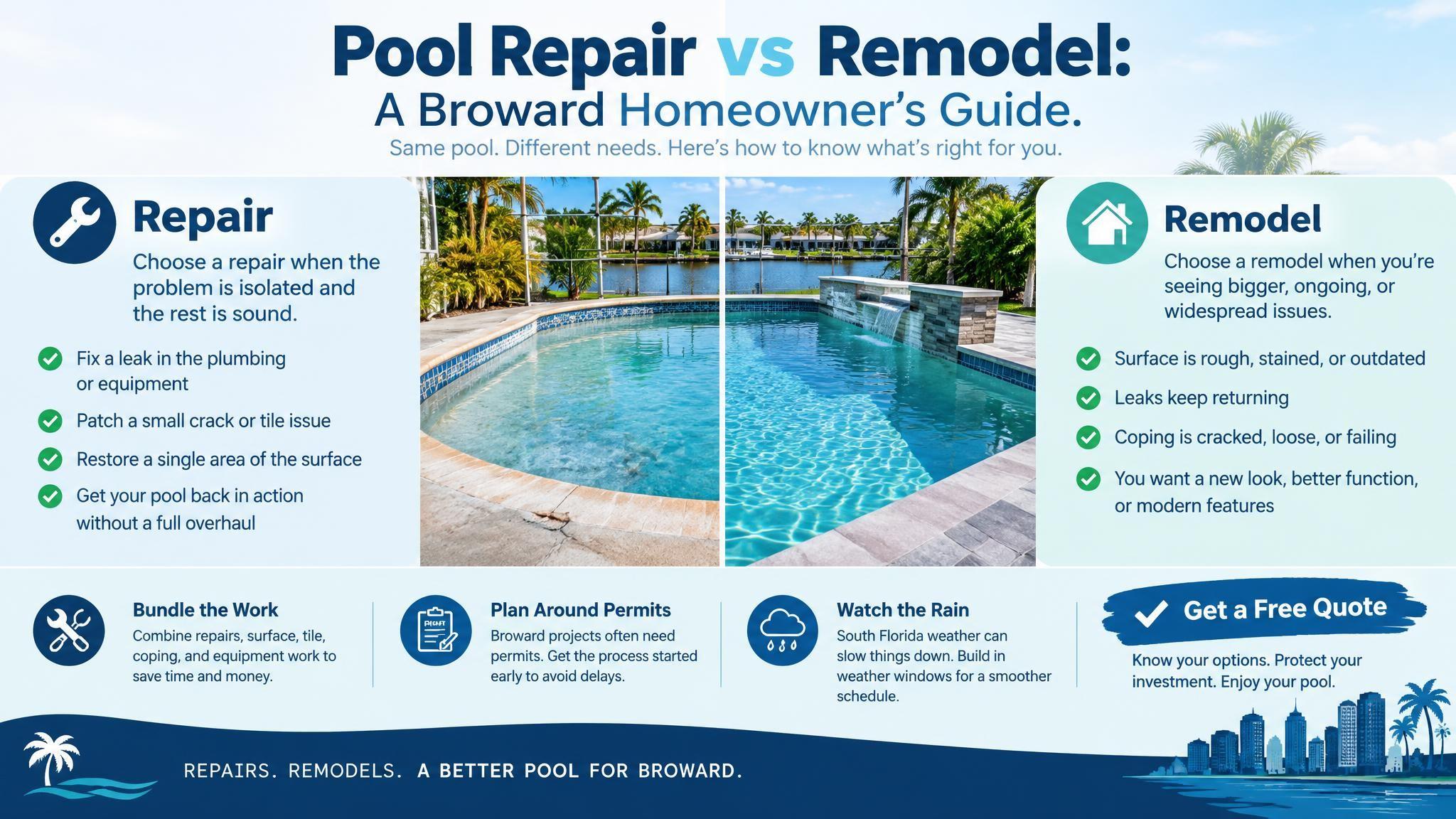
Repair when the problem is isolated and the rest of the pool is sound
If one pump, a few tiles, or a single diagnosed leak is the issue, repair it and move on. That is good stewardship, not a compromise.
Remodel when problems recur or the surface, coping, and equipment are all aging together
If the same issues keep returning, or the surface, coping, and equipment are wearing out at once, a renovation resolves the causes rather than the symptoms. It also gives you the chance to improve how the pool looks and works.
Next step: a free on-site quote
The clearest way to decide is to have someone look at your pool. Request a free on-site quote or call us at (954) 716-1236. We will walk the pool with you, explain what we see in plain language, and give you a transparent quote with no hidden fees.